

Inside the Surreal Birth of McDonaldland
If you are looking for the vintage 1970s psychedelic McDonald’s commercial, the strongest historical match is McDonald’s original McDonaldland television campaign—especially the first commercial, produced in 1970 and broadcast on American network television in January 1971.
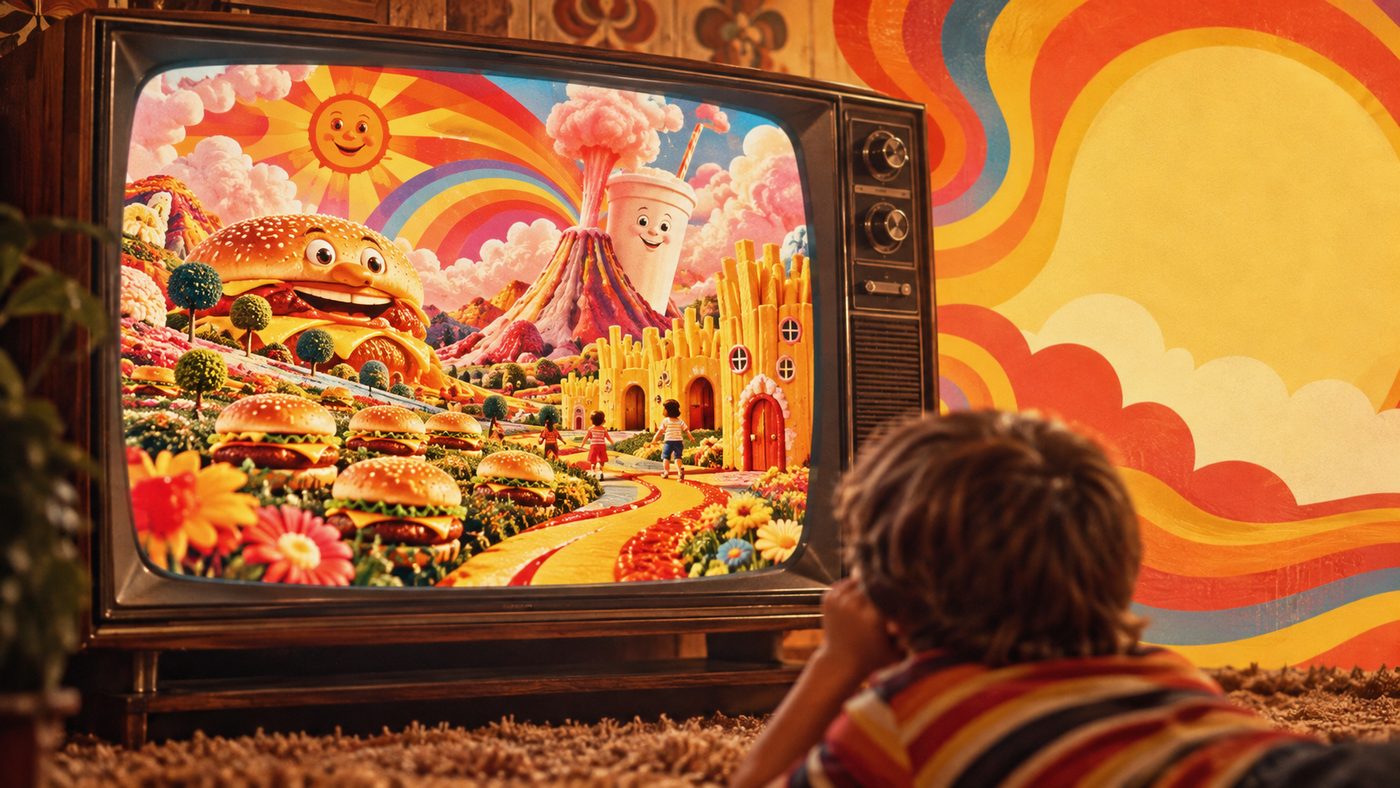
It was not officially advertised as a “psychedelic” commercial. That description is retrospective. But it makes sense when you watch it: Ronald McDonald leads children through a brightly colored fantasy landscape populated by talking food, hamburger-headed characters, Apple Pie Trees, Thick Shake Volcanoes, a French Fry Thatch and hamburgers that appear to grow from the ground.
More than fifty years later, even advertising creatives revisiting McDonaldland have described the original campaign as having a psychedelic, “acid trip” visual quality. shots
For researchers of psychedelic culture, however, the commercial is most useful when treated as something more complicated than a strange old fast-food advertisement. It demonstrates how the visual language associated with late-1960s psychedelia migrated rapidly into mainstream American children’s advertising and corporate branding.
What Was the 1970s Psychedelic McDonald’s Commercial?
The commercial most people are referring to is the first McDonaldland advertisement.
It was created during 1970 and first broadcast in January 1971. The Ninth Circuit’s later account of the McDonaldland copyright dispute confirms that the first commercials began airing nationally in January of that year. Justia Law
The premise is simple.
Ronald McDonald takes two children into McDonaldland, a fantasy version of the restaurant’s menu transformed into an entire environment.
Instead of merely seeing a hamburger advertised on a table, children encounter a world in which McDonald’s products seem to grow naturally from the landscape.
There are Apple Pie Trees.
Hamburgers grow in a Hamburger Patch.
French fries form part of the environment.
Milkshakes become volcanoes.
Human-scale characters include figures whose identities are literally constructed around McDonald’s food.
That combination is what gives the film its strange power today.
It is simultaneously a children’s fantasy, a corporate advertisement and an example of early-1970s surreal visual culture.
Why Does the Commercial Look So Psychedelic?
Calling the advertisement psychedelic does not mean that McDonald’s was promoting psychedelic drugs.
There is no need to make that leap.
“Psychedelic” can also describe a visual language that had developed during the second half of the 1960s: extreme color, distorted scale, anthropomorphic environments, fantasy landscapes, dreamlike transitions and worlds in which ordinary physical rules no longer seem important. You can checkout psychedelic products like LSD Gel tabs in this Swedish LSD Shop with beautiful psychedelics art.
The early McDonaldland commercials employ many of those devices.
Everyday objects become living beings
One of the defining features of McDonaldland is anthropomorphism—giving human characteristics to non-human things.
Hamburgers have eyes.
Trees produce food.
Menu items become characters.
The landscape behaves as though McDonald’s products have always belonged to nature.
This kind of transformation resembles the logic of psychedelic illustration and surreal fantasy: familiar objects remain recognizable while simultaneously becoming something impossible.
Scale no longer behaves normally
McDonaldland is filled with objects operating at incompatible scales.
A hamburger can be food in one moment and the head of an authority figure in another.
A milkshake can become a geographical feature.
Fast food becomes vegetation.
This matters because altered scale was common in fantasy and psychedelic visual culture. Changing scale destabilizes the viewer’s normal expectations without making the scene completely incomprehensible.
You still recognize the object.
You simply encounter it under impossible conditions.
The landscape behaves like a dream
There is little attempt to make McDonaldland resemble a realistic American town.
Instead, it operates through what might be called dream logic.
A child does not need an explanation for why hamburgers grow in a garden. Within the fantasy, they simply do.
That makes the advertisement immediately understandable to children while giving modern viewers the uncanny feeling associated with much late-1960s and early-1970s fantasy design.
Color overwhelms realism
The sets, costumes and characters privilege bright artificial colors over naturalism.
The goal is not to convince viewers that McDonaldland could physically exist.
It is to make the environment visually irresistible and instantly memorable.
That distinction is important.
Psychedelic design often works not by representing reality accurately but by increasing contrast, pattern, saturation and visual surprise.
McDonaldland converts those strategies into brand recognition.
The Commercial Was Really an Advertisement for a World
This is where McDonaldland becomes more interesting than a conventional food commercial.
A traditional advertisement might show a hamburger, describe its ingredients and tell viewers that it tastes good.
McDonaldland takes a different approach.
It creates an entire fictional universe around the product.
Children are not merely being shown food. They are invited to imagine entering a place where McDonald’s products, characters and symbols constitute the natural order.
That is sophisticated branding.
The restaurant is transformed from a physical place where food is purchased into the entrance to a fantasy world.
The Smithsonian describes characters such as Mayor McCheese and Officer Big Mac as members of a McDonaldland advertising campaign specifically directed toward children beginning in 1971. Smithsonian Institution
For media researchers, this distinction matters.
The product itself is no longer doing all the persuasive work.
The world surrounding the product becomes the advertisement.
Who Created McDonaldland?
McDonald’s advertising agency Needham, Harper & Steers developed the McDonaldland campaign.
But the origins of the visual concept became the subject of an important copyright case.
In early 1970, an executive from the agency contacted television producers Sid and Marty Krofft. According to the later federal court record, the agency told the Kroffts that it wanted to develop a McDonald’s campaign based on characters from their television program H.R. Pufnstuf. Justia Law
Discussions continued.
The agency subsequently informed the Kroffts that the project had been cancelled.
It had not.
The court record states that Needham proceeded with McDonaldland, hired former Krofft employees to work on costumes and sets, and employed the same voice specialist who had worked on H.R. Pufnstuf. Wikisource
That background is crucial to understanding the commercial’s visual appearance.
The H.R. Pufnstuf Connection
H.R. Pufnstuf debuted on American television in 1969.
Created by Sid and Marty Krofft, it used enormous puppets, human performers, elaborate fantasy environments and brightly colored sets to create a world radically separated from everyday visual reality.
McDonaldland followed a strikingly similar basic formula.
Instead of entering an ordinary restaurant, children entered another world populated by fantastical characters and living scenery.
The similarities eventually became a legal issue.
Sid and Marty Krofft sued McDonald’s and Needham, Harper & Steers for copyright infringement. The federal litigation established that the McDonaldland campaign infringed protected elements of H.R. Pufnstuf. Wikisource
The lawsuit is not a side note.
It is one of the best pieces of historical evidence available for understanding exactly how McDonaldland was created.
Rather than relying on decades-old internet speculation, researchers can consult the judicial record itself.
Was H.R. Pufnstuf Psychedelic?
This requires the same caution as the McDonald’s commercial.
The show clearly belongs to an era in which psychedelic visual conventions had become culturally recognizable.
Its brightly colored environments, bizarre creatures and surreal fantasy structures can easily be read within that context.
But appearance should not be confused with documented drug influence.
That distinction is essential for serious psychedelic research.
Something can participate in psychedelic visual culture without providing evidence that its creators were using psychedelic substances or deliberately representing a drug experience.
The same rule should be applied to McDonaldland.
The evidence supports calling the early commercial psychedelic-looking.
It does not justify claiming that LSD or another psychedelic directly caused its design.
The 1971 Commercial Was Only the Beginning
The original McDonaldland advertisement quickly developed into a larger series.
Characters included Ronald McDonald, the Hamburglar, Mayor McCheese, Officer Big Mac, Captain Crook and Grimace.
Early plots often revolved around someone attempting to steal a McDonald’s product.
The Hamburglar wanted hamburgers.
Captain Crook pursued Filet-O-Fish sandwiches.
The original Grimace—initially more villainous than the later friendly character—was associated with stealing shakes.
The fantasy format allowed individual menu items to become recurring narrative objects rather than products mentioned briefly at the end of an advertisement.
Archival and surviving-video records document a substantial run of McDonaldland commercials during 1971 alone, including stories involving the Hamburglar, Captain Crook, Grimace, the French Fry Thatch and other parts of the fictional world. YouTube
This repetition helped turn a commercial concept into a mythology.
The Hamburger Patch Is More Important Than It Looks
One of the strangest images in McDonaldland is also one of the most revealing.
Hamburgers grow from the ground.
From a child’s perspective, this is harmless fantasy.
From the perspective of advertising research, however, something much more interesting is happening.
The commercial removes food production from the product.
A hamburger does not come from cattle, agriculture, slaughter, processing, transport or restaurant labor.
It simply grows.
The product appears as an uncomplicated part of a magical environment.
This technique is not unique to McDonald’s. Advertising frequently simplifies the production history of consumer goods.
But McDonaldland makes the process unusually visible because the fantasy is so extreme.
A product becomes nature.
For researchers studying food advertising, childhood marketing or visual persuasion, the Hamburger Patch may therefore be one of the most useful images in the campaign.
A Psychedelic Aesthetic Without Psychedelic Politics
This is another reason the advertisement deserves serious attention.
Much psychedelic visual culture of the late 1960s became associated with counterculture, rock music, opposition to social convention and alternative ways of living.
McDonaldland borrows the visual freedom without carrying those politics.
The strange colors remain.
The impossible landscape remains.
The visual excess remains.
But the destination is a McDonald’s restaurant.
This is an important transformation.
The psychedelic aesthetic has been detached from much of its countercultural context and redirected toward consumption.
That does not mean McDonald’s consciously attempted to “commercialize LSD culture.” There is no need for such an unsupported claim.
What the evidence allows us to observe is simpler and more historically useful:
Visual techniques that would have seemed radically unconventional only a few years earlier had become available to one of America’s largest commercial advertisers.
From Counterculture to Corporate Advertising
The timing is significant.
The first McDonaldland advertisement aired in 1971—only a few years after psychedelic poster design, experimental animation and vividly colored youth culture had become prominent in the United States.
By the beginning of the new decade, those visual ideas no longer belonged exclusively to underground media.
Mainstream television had absorbed them.
McDonaldland therefore offers researchers an example of how cultural aesthetics migrate.
A visual style can begin in one context and acquire entirely different purposes elsewhere.
The distorted environments of psychedelic art might encourage viewers to question ordinary perception.
The distorted environment of McDonaldland encourages children to remember hamburgers.
Visually, the mechanisms can overlap.
Socially, their purposes are very different.
The Bubblegum Sound Matters Too
The imagery receives most of the attention, but sound is part of McDonaldland’s strange character.
The early commercials used cheerful, highly memorable music rather than the darker or more experimental sound commonly associated with psychedelic rock.
This is another clue to what McDonald’s was doing.
The campaign combined a visually bizarre fantasy world with reassuring, child-friendly music.
Instead of making the unfamiliar threatening, the soundtrack makes it playful.
The result is a useful example of how advertising can domesticate experimental imagery.
Surreal scenery becomes safe because the music, narrator and Ronald McDonald continually tell the child how to understand it.
Psychedelia Designed for Children
Calling McDonaldland children’s advertising is not speculation.
The Smithsonian explicitly identifies characters including Mayor McCheese and Officer Big Mac as part of McDonald’s 1971 advertising campaign aimed at children. Smithsonian Institution
That makes the commercial particularly relevant to researchers examining how psychedelic visual conventions moved between generations.
The original countercultural audience for psychedelic posters was largely adolescent and adult.
McDonaldland translates aspects of that visual vocabulary into something a young child could immediately understand.
The process strips away ambiguity.
A surreal landscape becomes an adventure playground.
A strange creature becomes a mascot.
An impossible transformation becomes a joke.
A psychedelic-looking environment becomes a branded childhood fantasy.
McDonaldland and the Rise of Character Marketing
The campaign also anticipated a form of marketing that would become increasingly powerful.
Consumers could form relationships with characters independently of particular food products.
Mayor McCheese was not merely an advertisement for a sandwich.
Grimace eventually became a recognizable character in his own right.
The Hamburglar had a personality, visual identity and recurring narrative function.
Characters could appear in television advertisements, merchandise and restaurant environments.
The copyright litigation itself records the significance of associated McDonaldland merchandise such as toys and puzzles. OpenJurist
This created something closer to an entertainment franchise than a conventional advertising campaign.
The commercial sold hamburgers.
But it also built intellectual property.
Why the Copyright Case Matters to Advertising History
Sid & Marty Krofft Television Productions, Inc. v. McDonald’s Corp. ultimately became an important copyright decision.
For a researcher interested primarily in psychedelic culture, however, the case is valuable for another reason: it preserves unusually detailed evidence about the production history of McDonaldland.
The court record documents the contact between Needham and the Kroffts.
It records the planned relationship to H.R. Pufnstuf.
It documents the hiring of former Krofft personnel.
And it establishes when the McDonaldland advertisements began appearing nationally. Wikisource
That makes the case far more reliable than nostalgic claims that have accumulated around the commercials online.
Not Every 1970s McDonald’s Commercial Was Psychedelic
This distinction prevents another common historical mistake.
McDonald’s was running other advertising strategies at the same time.
In 1971, Needham, Harper & Steers also developed the famous “You Deserve a Break Today” campaign.
Archival material held by the Smithsonian’s National Museum of American History includes McDonald’s television commercials from the period featuring the slogan and conventional restaurant scenes rather than fantasy-world narratives. National Museum of American History
So “1970s McDonald’s advertising” and “psychedelic McDonaldland advertising” should not be treated as identical categories.
McDonald’s could speak to different audiences simultaneously.
One campaign might emphasize cleanliness, convenience and the restaurant experience.
Another could send Ronald McDonald and children into a landscape of living hamburgers and milkshake volcanoes.
That contrast tells researchers something important about the sophistication of American advertising by the early 1970s.
Why Researchers Still Call the Original Commercial Psychedelic
The label persists because the resemblance is not subtle.
In discussing a modern McDonaldland revival, director Nick Roney said the production team looked back especially to the original advertisement, describing its style as psychedelic and comparing its visual atmosphere to an “acid trip.” shots
That is a modern interpretation rather than evidence that McDonald’s used the word in 1971.
The distinction should remain visible.
A careful description would therefore be:
The original 1971 McDonaldland commercial is a children’s fantasy advertisement that uses visual conventions now strongly associated with psychedelic design.
That is more defensible than claiming it was explicitly created as an LSD-inspired commercial.
What Psychedelic Researchers Can Learn From McDonaldland
The advertisement is valuable because it exposes several stages in the cultural life of an aesthetic.
First, visual experimentation emerges in art, music, television and youth culture.
Then those conventions become recognizable.
Once recognizable, they can be borrowed.
Once borrowed, they can be simplified.
Once simplified, they can be commercialized.
McDonaldland captures that process unusually clearly.
By 1971, imagery that could evoke altered perception, fantasy and surrealism was flexible enough to help sell hamburgers to American children.
That does not make McDonaldland psychedelic art in exactly the same sense as a San Francisco concert poster.
It makes the commercial arguably more revealing.
It shows what happens after an avant-garde or countercultural visual language becomes culturally legible.
A Better Way to Analyze the Commercial
Researchers viewing the commercial today should resist asking only, “How weird is this?”
A stronger analysis separates several questions.
Look first at the visual structure. What happens to scale, color, landscape and ordinary objects?
Then examine narrative function. How does Ronald guide children through potentially strange surroundings and make the environment feel safe?
Next consider commercial function. How does each fantasy element transform a menu item into something memorable?
Then examine cultural context. Why was this visual language understandable to American television audiences by 1971?
Finally, examine production history. How does the documented relationship with H.R. Pufnstuf change our understanding of where the imagery came from?
That method moves the analysis beyond nostalgia.
What We Can Verify—and What We Cannot
Several facts are well established.
McDonaldland was developed by Needham, Harper & Steers.
The first commercials aired in January 1971. Justia Law
The campaign was directed toward children. Smithsonian Institution
The agency had previously discussed developing the campaign using H.R. Pufnstuf, and the resulting similarities led to successful copyright litigation. Wikisource
The original McDonaldland world included fantastic food landscapes such as Apple Pie Trees, Thick Shake Volcanoes, French Fry structures and a Hamburger Patch. Chowhound
What is not established is equally important.
There is no basis for claiming that McDonald’s was promoting LSD.
There is no need to assume the commercial was produced under psychedelic drugs.
And describing the advertisement as psychedelic does not mean every viewer in 1971 understood it in those terms.
Those are different claims.
Why the Vintage 1970s Psychedelic McDonald’s Commercial Still Matters
The original McDonaldland advertisement is memorable because it occupies an improbable intersection.
It is corporate advertising and surreal fantasy.
It is children’s entertainment and product marketing.
It is visually connected to the late-1960s psychedelic moment while being designed for one of the most mainstream commercial purposes imaginable.
Most importantly, it shows how quickly radical-looking aesthetics can lose their original cultural boundaries.
Only a few years after psychedelic graphics had become closely associated with counterculture, similar visual strategies could appear on network television as Ronald McDonald walked children through a garden of living hamburgers.
That is what makes McDonaldland worth studying.
The commercial is not evidence that McDonald’s embraced psychedelic ideology.
It is evidence of something more historically interesting:
by the beginning of the 1970s, psychedelic-looking fantasy had become familiar enough to be transformed into mainstream American brand language.
For researchers interested in psychedelia, advertising and popular culture, the strangest part of the commercial may therefore not be the talking hamburgers.
It is how quickly the strange became marketable.
How to Study McDonaldland Frame by Frame
The early McDonaldland commercials reward close visual analysis because almost every part of the environment has been converted into branding.
A researcher can begin by temporarily ignoring the dialogue and looking only at the set.
What appears to be vegetation?
What functions as architecture?
Where are McDonald’s products placed?
Which objects have faces or personalities?
The answers reveal that McDonaldland does not simply contain advertisements. The environment itself has been constructed from the brand.
Colour and artificiality
The sets make little effort to imitate natural colour.
Instead, bright artificial tones help separate characters and objects from one another. This gives the environment some of the visual intensity associated with late-1960s psychedelic graphics while also serving a practical advertising purpose: important objects remain immediately recognizable on television.
This distinction is useful.
The colours can be psychedelic in appearance while still performing conventional commercial work.
They attract attention.
They separate foreground from background.
They make characters identifiable.
And they help turn food products into memorable visual symbols.
Food becomes landscape
Perhaps the most unusual feature of McDonaldland is the transformation of food into geography.
Hamburgers grow from plants.
French fries become part of the architecture.
Shakes can be represented as geological features.
Apple pies become connected with trees.
The result is a world in which McDonald’s food no longer appears to have been manufactured.
It appears to belong naturally to the environment.
That transformation deserves more attention than simply calling the commercial strange.
It is a powerful advertising device because it removes almost every stage between nature and consumption.
The child does not see agriculture, factories, delivery trucks or restaurant kitchens.
The finished food simply exists.
Anthropomorphism Turns Products Into Characters
Anthropomorphism means giving human characteristics to something that is not human.
McDonaldland relies heavily on it.
Mayor McCheese is perhaps the clearest example. His enormous cheeseburger head transforms a menu item into a political authority figure.
Officer Big Mac performs a similar transformation.
A sandwich becomes a police officer.
The Smithsonian’s National Museum of American History preserves both Mayor McCheese and Officer Big Mac dolls and identifies the characters as part of McDonald’s 1971 advertising campaign aimed at children.
This is significant because it demonstrates that the characters were not confined to television.
They became physical objects.
A child could encounter McDonaldland on television and then encounter the same fictional world through toys and other merchandise.
The brand was beginning to function less like a series of isolated advertisements and more like a fictional entertainment property.
From Television Commercial to Brand Universe
The McDonaldland campaign anticipated a marketing strategy that is now commonplace: building a fictional universe around a commercial brand.
Modern audiences see versions of this everywhere.
A company does not simply sell a product. It develops characters, stories, environments and recognizable visual rules.
McDonaldland was doing this more than fifty years ago.
The federal copyright record notes that the campaign expanded into toys and games as well as television advertising. It also records that H.R. Pufnstuf characters had previously been licensed for products including toys, games, lunch boxes and comic books—one reason the commercial similarity between the two properties became economically important.
This suggests a useful way of interpreting McDonaldland.
The advertising agency was not merely asking:
How can we make children remember a hamburger?
The larger question was closer to:
How can we make children remember an entire world in which the hamburger belongs?
That is a substantially more sophisticated branding strategy.
McDonaldland and H.R. Pufnstuf: What the Historical Record Actually Shows
The relationship between McDonaldland and H.R. Pufnstuf should not be treated as internet folklore.
There is unusually strong documentation.
The Ninth Circuit’s account of the dispute records that Needham, Harper & Steers contacted Sid and Marty Krofft about developing a McDonald’s advertising project associated with H.R. Pufnstuf. An August 31, 1970 letter stated that the agency was proceeding with a McDonaldland campaign based on the television series and discussed paying the Kroffts for design and engineering work.
The Kroffts were subsequently told the project had been cancelled.
According to the court, it had not been cancelled.
Needham continued developing McDonaldland, hired former Krofft employees to work on costumes and sets, and used the same voice specialist who had supplied voices for Pufnstuf. The first McDonaldland commercials then reached network television in January 1971.
For researchers, these details matter because they replace visual guesswork with production evidence.
It is easy to watch the two properties and say they “look similar.”
The court record tells us something much more useful: there was direct contact between the creators, discussion of a project based on Pufnstuf, overlapping production personnel and subsequent litigation.
That should form the historical foundation of any comparison.
The Commercial Should Not Be Used as Evidence of LSD Influence
Researchers should be particularly careful here.
The fact that McDonaldland resembles psychedelic visual culture does not establish that LSD or another psychedelic drug directly influenced the production.
Those are different kinds of claims.
A visual comparison might support statements about:
psychedelic colour;
surreal environments;
distorted scale;
fantasy creatures;
unusual typography;
or dreamlike transformations.
It does not establish what substances anyone involved had used.
The distinction may seem obvious, but it matters because psychedelic history is often weakened by retrospective assumptions.
By the late 1960s, psychedelic imagery had already entered popular graphic culture. The V&A’s archive of Oz magazine, for example, documents psychedelic covers by Martin Sharp within a broader countercultural environment spanning acid, music, politics and alternative culture between 1967 and 1973.
Once an aesthetic becomes recognizable, commercial designers do not need to share the circumstances that originally produced it in order to borrow its visual language.
That is precisely why McDonaldland is historically interesting.
McDonaldland Was Only One Side of McDonald’s Advertising
Researchers should also resist treating every McDonald’s advertisement from the early 1970s as part of the same psychedelic campaign.
McDonald’s was using multiple advertising approaches simultaneously.
The Smithsonian’s Needham, Harper & Steers archive contains more conventional McDonald’s commercials from the period. A 1971 advertisement, for example, focuses on cleaners working inside a restaurant while using the “You Deserve a Break Today” campaign. Another 1971 commercial shows how much McDonald’s food a customer could purchase for one dollar.
These advertisements are valuable comparison material.
They demonstrate that McDonaldland was a creative choice, not simply what all McDonald’s advertising looked like at the time.
One side of the brand could communicate affordability, cleanliness and convenience.
Another could contain Mayor McCheese and a landscape where hamburgers grew from the ground.
Studying the two approaches together gives a more accurate picture of early-1970s American advertising.
Psychedelic Design Becomes Safe
One of the most revealing characteristics of McDonaldland is how harmless everything ultimately feels.
The environment is bizarre.
The characters are physically impossible.
The scale is unstable.
Objects become creatures.
Food grows like vegetation.
Yet Ronald McDonald acts as a guide.
The music is cheerful.
The narrative gives the viewer simple goals.
Good and bad characters are easily identified.
The strange environment therefore rarely becomes genuinely threatening.
This is an important difference between experimental psychedelic imagery and commercial psychedelic imagery.
Advertising has to control the strangeness.
The world can appear unusual enough to attract attention, but it must remain understandable enough to support the product.
McDonaldland turns visual disorientation into play.
Why Children Were Central to the Strategy
The Smithsonian explicitly describes Mayor McCheese and Officer Big Mac as characters from a McDonald’s advertising campaign aimed at children beginning in 1971.
This helps explain several design decisions.
Children do not need to understand psychedelic art history to respond to bright colours, oversized characters or impossible environments.
They understand fantasy.
The commercial therefore translates visual qualities associated with psychedelic and surreal design into the familiar grammar of children’s entertainment.
There are heroes.
There are villains.
There are recurring locations.
There are jokes.
There are recognizable characters.
And behind nearly every one of them is a food product.
That combination makes the campaign useful for researchers studying the point where entertainment and advertising begin to merge.
McDonaldland as Early Transmedia Marketing
Today the word transmedia is often used when a fictional world spreads across several media.
A character might begin in a film and then appear in games, toys, social media and merchandise.
McDonaldland used a comparable strategy decades earlier.
Characters appeared in television commercials.
Physical dolls survive in the Smithsonian collection.
The court record documents toys and games connected to the campaign.
McDonald’s archival advertising collections also contain a much broader range of promotional objects—including balloons, puzzles, coupons, placemats, bags and calendars—showing how extensively the company used physical promotional material to carry its brand into everyday life.
For researchers, this means McDonaldland should not be studied exclusively through surviving YouTube uploads.
Television was only one part of the system.
A Useful Research Method for the Commercial
A strong analysis can separate the commercial into five layers:
- Visual language: colour, scale, set design, costumes, typography and surreal transformations.
- Narrative: who guides the viewer, who creates conflict and how the problem is resolved.
- Product integration: where McDonald’s food appears and how it becomes part of the fictional environment.
- Audience strategy: how potentially strange imagery is made understandable and attractive to children.
- Historical production: the documented relationship with H.R. Pufnstuf, Needham, Harper & Steers and the 1971 launch.
Using these layers prevents the analysis from becoming simply a collection of observations about how bizarre the commercial appears today.
Primary Sources Researchers Should Prioritize
For historical work on McDonaldland, not every online source deserves equal weight.
The strongest starting point is the 1977 Ninth Circuit decision inSid & Marty Krofft Television Productions, Inc. v. McDonald’s Corporation because it documents the development of the campaign, the agency’s interactions with the Kroffts, overlapping production personnel and the January 1971 television launch.
The Smithsonian National Museum of American History provides useful material evidence through surviving McDonaldland objects and its advertising archives. Its records independently confirm that characters including Mayor McCheese and Officer Big Mac belonged to the child-directed 1971 campaign.
Surviving television commercials themselves should then be treated as primary visual evidence.
Collector websites, nostalgia blogs and retrospective videos can help locate material, but they should not become the sole evidence for important historical claims when stronger documentation exists.
Questions the Commercial Leaves for Psychedelic Researchers
The campaign opens several productive lines of inquiry.
How quickly can a countercultural aesthetic become commercially acceptable?
What happens to psychedelic imagery when its political and spiritual associations are removed?
Can a visual language still be called psychedelic when it is being used to sell fast food?
How did children’s fantasy television help corporations translate surreal imagery for younger audiences?
And at what point does advertising stop merely presenting a product and begin constructing an entertainment universe around it?
These questions make the vintage McDonaldland commercials useful far beyond nostalgia.
A Final Research Perspective
Watching the original McDonaldland commercial today, it is easy to laugh at its strangeness.
That reaction should be the beginning of the analysis, not the end.
The commercial sits at a remarkable cultural intersection.
Its fantasy world has connections to late-1960s psychedelic aesthetics.
Its production history is tied directly to H.R. Pufnstuf.
Its characters were designed to communicate with children.
Its products become landscapes, personalities and narrative objects.
And all of this served one of the most mainstream commercial brands in the United States.
The important historical shift is therefore not simply that McDonald’s once made a bizarre advertisement.
It is that by January 1971, a visual language built from surreal environments, extreme colour, anthropomorphic objects and altered scale had become sufficiently familiar to appear on American network television as children’s fast-food advertising.
That is what makes McDonaldland valuable to psychedelic researchers.
It documents a moment when the visual grammar of the strange had become part of the grammar of ordinary consumer culture.


